
Mindfulness, Your Environment Matters, and the Wheel of Health with Melissa Smith
May 15th, 2025
Jump to
Description
Melissa Smith discusses her commitment to well-being and finding balance, particularly for women in corporate roles. She highlights the importance of her morning routine, which includes reading, meditation, and exercise, starting at 4:30 AM. Melissa also emphasizes the significance of sleep and rest, even suggesting short naps as a way to re-energize during the day. She introduces her “Wheel of Health” concept, which extends beyond physical fitness to include mental and environmental factors. Finally, Melissa stresses the value of knowing one’s personal values and priorities as a guide for decision-making and achieving fulfillment, both personally and professionally.
Listen
Watch
Guest

Melissa Smith, MBA is a dynamic professional who seamlessly integrates whole-person health and wellness into her daily life. By day, she works as a manufacturer’s representative for Pakoil Company, where she helps businesses in industrial manufacturing, medical device production, and specialty packaging find solutions that drive efficiency and success.
A firm believer in lifelong learning, Melissa is currently pursuing her Health & Well-Being Coach Training certification at Duke University. Alongside this journey, she launched Balance and Bloom, a health and wellness coaching business dedicated to helping women in corporate and leadership roles rediscover their spark and reclaim their joy.
Beyond her career, Melissa is a devoted wife of 17 years and mother to three boys (11, 13, and 15). She starts each day at 4:30 AM with journaling, mindfulness, meditation, and a gym session, embodying the balanced lifestyle she teaches. Committed to service, she is a Sunday school teacher and board member at two of her sons’ schools. At home, she shares her active lifestyle with two spirited standard poodles.
Driven by a passion for balance, well-being, and high performance, Melissa is on a mission to empower women to take control of their health, happiness, and confidence—both professionally and personally.
Show Notes
Transcript
Dave
[00.00.00]
So I was getting ready this morning. I woke up around six. My routine is I get the dog up and move in, feed her, try to hit the coffee before she wants to go out. And it’s 620 and I’m standing in the rain. And then I realized that my guest today has already been up for 90 minutes, crushing it and doing things, so I felt like a slacker. Welcome to the Agency Balance Podcast. I have a great guest for you today, Melissa Smith, MBA. Welcome, Melissa, to the podcast.
Melissa
[00.00.35]
Thank you Dave.
Dave
[00.00.36]
So happy to have you here. By day she works as a manufacturer’s representative. She’s a firm believer in lifelong learning. I always say always be learning. That’s one of the things that we say here at SmartAcre. You’re currently pursuing your health and Well-Being Coaching and Training certification at Duke University. Go, Duke. And beyond that, a wife, three boys. You know, you tell the story. You tell. You tell the story. And what? You got a lot going on. Where do we start?
Melissa
[00.01.17]
I like to stay busy. I guess we could start with the routine.
Dave
[00.01.20]
Yeah, let’s follow the routine. Because you got. You got the 430. You said. You said that you start your day at 430. Is that for
Melissa
[00.01.26]
real? Every day. Oh, yeah. Even if I don’t set my alarm on the weekends, I am usually up by 530, 6:00 at the latest. I love my mornings, I love it. And I know you, and probably a lot of your listeners have been up at that time. And and I try to think about why I like that time in the morning. Because there’s a lot of people hate, hate that, you know, they don’t want to get up that early. But when I think about what it seems from when we we would go on one vacation a year, my parents, my dad had off one week a year, and we always made a big deal. We went down to South Carolina and we drove, and we would get up at 4:00 in the morning. And the thing was, it was so exciting because we knew that we were going on vacation. And the sun is, you know. So that feeling, I still feel like I have a little bit of that feeling in the morning, like, what’s the day going to bring? It’s so exciting. What’s going to happen today, you know? And so I really think that that’s where it started. Um, I wasn’t always like that, but I did start probably in my 20s. Uh, I had a co-worker that said, let’s go to the gym tomorrow morning. I said, okay. She said, okay, I’ll pick you up at five. The gym opens at 530. I was like, what? Are you kidding me? I’m 25 years old. I was probably just getting home. And, uh, she. So she did. She picked me up at 530. And I loved it. I was like, this is. This is where I’m meant to be at that time in the morning. And I get it done. And, you know, when everybody else is waking up, I’ve already had a couple hours in and I. I work out and I, you know, come home and I take my shower before I even get to the gym, though, I, I love, um, reading. I, you know, I, I sit down and I read maybe 15, 20 minutes and, um, meditate for another 5 to 10 minutes and then, you know, head off to the gym. But I that that morning routine now I actually started journaling too. I’ve been journaling. And so that whole morning routine has really, really helped. Okay. So there’s a lot there. We’re gonna we’re gonna break that down. Okay. And and Melissa has. Great. I just want to say stick stick with us because she has a methodology and she’s got some great resources for all of you that if you’re if you’re listening and going, there’s no possible way I’m getting up that extra early to do one of these things. Maybe by the end of this, this episode, you’ll change your mind. I don’t get up that early, but I, I, I’m like the second one up. So my son gets up really early about that time almost, which is crazy. And he’s in school, so he gets up and he’s gone. But I’m I’m also like. Like, like 30 to 45 minutes doing my routine. Like having my cup of coffee. I, I sit in this the same chair every morning and I look outside and all that and the the weather’s changing and all that. So I get where you’re I get where you’re coming from there. Um, so so you so you do that. Well, how does your day end? Let’s just. How does your day end then? So that’s the the other side of it. I’m very lucky that I’m a morning person and my husband’s a night person. So I’m doing the daytime stuff. You know, I’m getting the kids ready for school and packing lunches and kind of getting them out the door, whereas I’m in bed by 830, 9:00 at the latest, and they are not. Um, so he kind of takes over the nighttime routine, uh, because, you know, I think sleep is, is super important. And I really like to stay on schedule. So if I’m up at 430, you know, I, I’m hitting a wall by 8:00 and my brain is mush, and it’s time for
Dave
[00.05.12]
bed. Yeah. Sleep, sleep absolutely is key for me to. I cannot if I don’t get a good night’s sleep, I am wrecked. I do not function well. I can’t think right. I can’t bring the energy that I’m supposed to bring and whatever I’m doing. So I totally get that sleep is right off the bat. Do you have any tips for, if you’re, like, off schedule to get on schedule or talk about sleep? I think that’s so important.
Melissa
[00.05.39]
It is. And, um. I also learned this from my mom. My mom? My mom was a stay at home mom, and, um, she took naps during the day. And sometimes people have a bad, um, stigma on naps. They’re like, naps make you you’re lazy. If you’re taking a nap. Or how do you have time to take a nap during the day? And I am lucky enough that I work from home and I don’t nap every day. But there are some times when I didn’t sleep well, or maybe sometimes I had to get up extra early in the morning or I didn’t get, you know, the sleep that I should have. I’m okay with taking a 15 or 20 minute nap, um, and then getting up, having a cup of coffee, feeling energized because everybody knows that feeling around 2 or 3:00 in the afternoon when your brain is starting to become mush, you’re no good to yourself. You need to take some type of break. And if you’re not at home and you’re not able to actually lay down, go find a chair. Go out to your car and put the seat back a little bit. Um, go take a walk down the hall, take an extra, you know, take your dog out. Whatever you need to do. Don’t keep on sitting at your desk because that’s not doing your brain well. You’re not that’s not doing your body well. That’s not doing your work. Well, you you definitely need to take that break.
Dave
[00.07.01]
Yeah. Move breaks are super important. I started I think I’ve said this before. Every call I take, I try to stand and move when I take a call and then like reserve when I’m doing, like heads down work actually sitting. So I’m like up and down, up and down, up and down. Those are those are really good tips. I like to listen. If you’re working in a place where you can take a nap, like go out to your car, I think that’s a great idea to go out to. Your car falls. Just don’t like put your turn your car on and fall asleep or fall asleep. I know years ago, I were years ago, I worked with a guy who fell asleep on his lunch break and I don’t even know. It was probably like a piece of joiners. And he. And he didn’t come back in, and his car was running and he fell asleep in his car. So don’t do that. No, don’t do
Melissa
[00.07.43]
that. And don’t take more than 15 or 20 minutes either. Okay, that’s a good tip because I always say if you’re taking an hour, yeah, it’s no longer called a nap. It’s now it’s sleeping, you know. So just take that 15 or so and I’m not actually falling into a deep sleep. What it is, is you’re just relaxing your mind and you’re relaxing your body, and you’re kind of like, in a state of a little bit of unconsciousness, if that makes sense. Just enough to bring your energy levels back up and be good for the rest of your day.
Dave
[00.08.15]
Yeah. Yeah. Okay. So we’re laying it down for our listeners. That’s some good pro tips then. So.
Melissa
[00.08.27]
How
Dave
[00.08.27]
did how did you get. How did how did this all start. Like at what point did you go. You know what I’m going to. I’m going to switch some things up here. And and really start to focus on on journaling and mindfulness and meditation and like was there a trigger point for this or was this like, was it that gym session that you went to at 5:00 in the morning?
Melissa
[00.08.49]
Uh, I’ve always been healthy. I saw, like I said, my mom was a stay at home mom, and she always exercised and ate right and took naps and did all the things. Um, but I think possibly being in sales, you know, helped me say to myself, okay, I don’t want that burnout. A lot of people in sales, they just they get that burnout and they are just the world that we used to live in and probably still live in a little bit. Now is work, work, work, work, work never stop, you know, continue to make all the money. Don’t your your health is secondary to, um, your career and your job and the nice thing which the world that I’m living in and, and I’m paying more attention to this is that that flip is coming, and now it’s you need to pay attention to your mind and your body in order to be. Driven and be successful in your career. So now that flip is happening, and it’s not those people that are the go getters that never stop and sleep and don’t eat right and drink too much. Those are not the people that people are looking up to anymore. Now it’s the people that are saying, you need to slow down and take care of yourself.
Dave
[00.10.00]
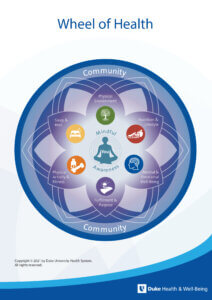
Yeah. Yeah. It’s I mean, it’s it’s any age. It’s it’s any age. You should should be thinking about this stuff. I’m going to show on the screen. And if you’re listening on, um, if you’re listening on Spotify or Apple Hop over to our YouTube channel, uh, because we have some visuals here. You have this called The Wheel of Health. I’ll I’ll show it up here. And this is the point of the wheel. Can do it. The wheel of health I like wheels. All different type of wheels. I’m a big fan of wheels. Um, so you have community. There’s in the middle is you write mindful awareness and then all these things that you’re talking about, sleep and rest, physical activity, um, the environment that you’re in, all of these. Talk to me about this. Like how does this play into everything?
Melissa
[00.10.46]
So what you just mentioned, environment is not really something that I think a lot of people think about when they think about their complete wellness. So you’re in the middle and you have the first thing that people will think of is their physical health. And it’s if you talk to ten people, probably nine of them say, yeah, I’m healthy, I eat great, and I exercise. Those are those are the two things that people think about. But does anybody think about what you put in your mind as much as what you put into your body? Do you think about the people that you’re hanging with? Do you think about what you’re reading? Do you think about the news that you consume? Do you think about, um, how you feel after your day of work or, you know, the friends that you keep with you? Those are just as important as you. Not always eating, you know, high sugary foods and drinking sodas. Yeah. So, um. It’s it’s really a balancing but also the environment. The environment is so important. Sometimes people say, you know, I’m really looking for that balance. And I eat right and I exercise and I’ve got and I read and I have a good mind. Um, but there’s something still off. And so then I would ask them, well, what’s your environment at home like, what is your environment at work like do you you know, we’ve all had that feeling where your house, let’s say you’ve been running, you just got home from vacation and your bags are still in packs. And you know, you’re just trying to catch up from things and the house is a mess and you need to clean and there’s dust. You don’t feel good about that. Right. That that it clogs your mind. And the second you clean your house and just a little bit, you know, you just tidy up a little bit and you run the vacuum and you put your stuff away. Don’t you feel like, okay, you know, that feels better. So sometimes when you’re off balance, you really need to check your environment and say, what’s going on around me that could be throwing me off.
Dave
[00.12.40]
Yeah, that’s a good that’s a good tip. It’s a good thing my mom, like, scolded, scolded me for not keeping. My stuff clean at home. Like I my house was always nice and neat and everything had its place and we got in trouble. I still get to if I go to my mom’s house today, it’s still very nice and neat if I touch something my mom knows. So I blame her for for being like like everything, having a place and being a little OCD. The people that work with me know that I’m a little. I’m a clean freak. I’m a germaphobe. Like way before the pandemic, I was a germaphobe. Like, not like like I can’t touch doorknobs and things like that, but like, I, I was a guy that had hand sanitizer in my pocket. Like, I needed to have everything clean. And I think you can get to the extreme to where that’s also not good for your your health, where you’re just, like, so hyper focused on being, you know, super clean about stuff. But I don’t know, I just, I know I feel better if I’m in an environment that’s clean, that it’s, you know, good light. You know, I, I hated working in places where there was no windows, like, I worked in a place I had no windows called it the Bat Cave. I hated it, you know. And so like, I need to be with light, like, gives me energy. Um, and if you can’t do that, then always, you know, we all have the ability to, to move and and go to somewhere where you’re going to. Draw. Draw. Draw from that energy. Right.
Melissa
[00.14.07]
Well, and speaking of the light, I know you told me that you just got back from this vacation with your family, and you went in, what, January? Yeah. So there are so many people out there, especially in Pennsylvania, Northeast region, that have these winter blues. Yeah. And there’s not a lot of research that is done on the winter blues because it’s it’s it’s just not a study thing. You know, you know, is it depression? Is it just the blues. How severe is it? A lot of people have different kinds of tendencies. But, um, it’s because of the lack of light. It’s because of the gloominess. It’s because of the lack of vitamin D. So I do recommend I have a light on my desk that I use that simulates sunlight. And you can buy it on Amazon. Um, so I also use it as my, you know, light when I’m on zoom calls. But, um, this light simulates sunlight, so you put it on first thing in the morning, um, for an hour. And then when I get back from lunch, I put it on because, you know, that that drain in the afternoon after you’ve had something to eat, get a little tired. So I put it on the afternoon and that really, really helps. And that’s also something you can do in the afternoon. Just get out in the sun. Sometimes I just go out in the sun and I sit there for five minutes, and just that just makes you feel so much better. Oh,
Dave
[00.15.20]
yeah. I try to take, like, I try to take my calls out there. Yeah, I try to take my calls. I don’t think have to. Like, we’re way past, like apologizing for anything that’s going on in the background. If you’re like in a virtual zoom environment, like you could totally do it, just go out and do it. I love that. And a lot of these resources that we’re talking about today. Check out agency balance.com. Click on Melissa’s episode. And also it’s all going to be linked over to her website which is balance and bloom life that life. Okay. So balance and bloom life I like that life as well. Um all right. So this wheel of health that we’re talking about heal. But there’s one other thing that I want to just touch on real quickly here because the obvious things are there, right? Um. Fulfillment and purpose that really stood out to me because there is a there was a question you that you had on this thing, which we’ll talk about in in another minute, which is like if you look back when you’re like 90 something years old and you look back on yourself like, what was your fulfillment like, what was your purpose? It’s so kind of like, what’s your purpose in life? But like, I think that’s really important, is it? Talk to me about that.
Melissa
[00.16.32]
The way people feel when they’re talking about what they do on a daily basis, you can tell in their eyes, you can tell by their energy. You can tell by how giddy they get. Um, if they are fulfilling their purpose, they are going to be sitting up straight and they are going to be telling you every. And it might be too much information. It might be, you might say, okay, okay, okay, I don’t need to talk about this anymore. Um, so that is that is such an important aspect of your life because do you want to look back when you’re 90 years old and say, I wish I would have done this, I wish I wouldn’t have done that, I wish, you know, and but again, I do feel like the world that we’re living in is turning into the direction of your values. What are your values? And you can you can find your purpose by stating your values. And that’s how you make all your decisions in life. So my number, my values are my family comes first, um, you know, then my my health and wellness, uh, and then my career and, you know, and that’s how I base decisions. So I think I was telling you when we were talking about, um. My I had this appointment that I had been trying to get with a customer forever, and he finally gave me this appointment and it happened to be on the same day as my son. He had a big project at school and he wanted me to be there, and I cancelled with my client because clients come third. You know, my my career comes third, my family comes first. And he was so understanding because he had, you know, he had kids and he understood that he’s no problem. And we, you know, we rescheduled for another day. But that was that was something I didn’t have to overthink. That was something that I didn’t have to say. Did I make the right decision? Do I make the wrong decision? Should I even do this? I’m not going to do this, you know, because when you set your values and you have your priorities, all you have to do is look at that checklist and say, where is this in my in my line of priorities. And then that’s how you base your decisions.
Dave
[00.18.38]
That’s really good, I think. And and sharing those priorities with everyone around you, both personally and professionally, is really important to. So they understand that because let’s all face it, we all have this fear. Like if you’re in a role in your job and you’re like, if you do something like that, your boss is immediately going to go, what the heck? You know what’s going on with this? You know, like what’s going on here? So like if if communication, I think is really important with that. Share that. That’s a that’s a great, great tip. I did it to you too I actually we I had to reschedule our our our first recording here too because my family does come first too. My, my dog is part of my family. She’s doing well,
Melissa
[00.19.12]
by the way. Good. Yeah. So when I saw that, I was like, she was in she was in here yesterday for the first time. So my my dog, my my my little beagle, everybody, there’s a picture up on agency balance. She’s 12 now and she just had like CCL, ACL surgery. She blew up both of them in the back. So we only had we only did the one. So the other one’s like hanging on by a thread. Oh my god. What is she doing. Great. She she she’s a smaller dog too. So like, you know, really she’s she’s my jam though. I had her on. She was, she was walking around on sales calls yesterday and she was in my background and everyone was commenting on her. They’re like, oh, is that a little beagle back there? We have another beagle in here today. His name is Hank. Was he over there? No. Oh, he must have been outside. Oh,
Dave
[00.19.56]
afterwards. Well, Hank’s. Hank’s a legend in the Beagle world.
Melissa
[00.20.00]
Okay. You know, that’s another form of of health and wellness. Bringing your pets to work or, you know, petting or going out and and walking your dogs. That type of dogs and cats, I mean, I we have a skink at home. Oh, what a skink. Oh,
Dave
[00.20.14]
please tell our listeners what that is if people. Because not not every day you hear that word.
Melissa
[00.20.20]
Um, it’s. So it’s just. It’s a lizard reptile. But it’s for anybody that is thinking about getting a reptile. And you want to start somewhere. I would recommend the skink because, I mean, I’ve. I don’t know if you remember this about me, but I had an iguana growing up. No, I had a 5.5ft iguana because I was allergic to cats and dogs. And so my parents got me an iguana. And it, you know, it was my it was like my dog. But. So I’ve always been into reptiles. And my youngest, he we went to a reptile exhibit in December and we bought a skink. And this thing is she is the sweetest, easiest to take care of. Animal. She’s, you know, maybe this big. No teeth. There’s no hostility. She eats cat food twice a week. That’s it. You have to. You know that they require a heat lamp and that’s it. That is it.
Dave
[00.21.14]
Oh, well, that. I think maybe in the next go around, I will. I’ll go down the skink route because I don’t want to be replacing AC anymore. What they cause. Oh
Melissa
[00.21.25]
my God, you live a long time though. They live like, uh, about 20 years. 20. So you’ll have a you’ll have them for a long
Dave
[00.21.31]
time. That’s a long time for a small reptile. Mhm. Awesome. Okay. Cool.
Melissa
[00.21.37]
Well how we got on. Well I don’t know. Yeah. This is what happens but I’m glad we did. I’m gonna go half step back. You mentioned something. Did you like, did you remember that I had this I didn’t because this is this is where we lift the curtain back a little bit. I went to high school with you, Melissa. That’s right. We did.
Dave
[00.21.53]
Okay, so.
Melissa
[00.21.55]
Bulldogs.
Dave
[00.21.56]
Bulldogs! The Bulldogs! Um. Um. Huh? So what did you think about me in high school? This is, um. I don’t know the answer to this, by the way. So this is, um. You can tell it. You can totally tell it like it is. What did you think of me? So the first thing I. There are two things that pop in my head right away. If you would have said what? What was Dave Snyder like in high school? The first thing I would say is funny. You were kind of like a comedian. You know, you made people laugh and, um, you were friends with Dana. You know, Dana always made us laugh, too. So but with you and Dana, it was like Comedy Central. But the other thing I remember is your buggy, your, uh, your bug, my Volkswagen, your Volkswagen. Yeah. And that you were a car guy and that, um, you know, I just whenever I actually still today, whenever I see a Volkswagen, I think of you because I also used to pass your house on the way to my house. Okay. And and so I, you know, and I would always see the car in your driveway.
Melissa
[00.22.56]
Um, so those are, those are the, the two things definitely funny comedians laid back. Um, and and that you were a car guy.
Dave
[00.23.04]
Well, yeah. I mean, that’s still today. I don’t change and nothing has changed in 30 years or dare. How long we say that? How old we are now. But, uh, yeah. Volkswagens still. Still like like cars. I think cars are very much an extension of your personality. For the most part, I think there’s definitely that you can say, like people just think, oh, I don’t care. It’s just it’s a vehicle. It’s just to get me to point A to point B, and that’s fine. Like actually with today’s economy, that’s the way you should think. Don’t buy a new car. Save your money. Um, but I do think your car is a reflection of who you are, whether if it’s clean, um, the style of it. Like, is it slow? Is it fast? Is it a truck or are you utilitarian or your SUV? I think it’s an extension of I still have a bright blue car. It was blue. It was blue back then, and I still have a bright blue car.
Melissa
[00.24.00]
Do you remember my car? No, we called it the Taz Mobile. Oh it was.
Dave
[00.24.05]
You were really into Taz. That’s
Melissa
[00.24.07]
right. I had Taz all over the place, and my dad was a car guy. He was a mechanic, and, um, so it was a Dodge Charger, but he said, um, you can paint it any color you want. So I painted it Mystic Teal. It was the color that had just come out on the new Camaros that was like that green. It’s actually kind of like, uh, you know, shimmered green and yellow. Um, but that was that was my first
Dave
[00.24.33]
car. Well, I’m going to Google image search that and put that up for anybody. There was a period of time in the 90s if you had like a car like that, that you were. Yeah, the bug was I bought my first car for 500 bucks, and I fixed it up with my dad. Right. And it took me, like, two years to fix it because I think I only had it as a senior. But drawing back to something that you said earlier, like one of the things that my dad taught me was like, we talk about purpose, like circling back to purpose because he’s like, he indirectly taught me this. I don’t because my dad doesn’t even listen to this. My dad doesn’t even know what a podcast is. But he was like, do everything that you can to the best of your ability. Like, no matter what my dad did. Like, I think if I said, like, I’m doing this thing, I’m with my dad right now, there’s like, it’s kind of like Mad Libs style where you’re like asking questions. And I’m secretly writing a book about my dad. Yeah. So like, before it’s too late, like, yeah, I’ll send you, I’ll, I’ll link it up. So anybody you said you can do it for your mom and your dad. You basically ask him questions and you’re filling this out. And at the end it publishes a book about your parents. So I’m asking them all these questions about it, and He just no matter what he’s doing, whether if it’s like fixing something or tinkering with cars or like helping us out, he’s he doesn’t half ass anything. And I’m trying to distill that. Like on my kids, it’s like, no matter what you do, just do a good job about it. Like, people were like, just care. Yes.
Melissa
[00.26.00]
You know, when you go, when you’re at a restaurant and somebody is doing a phenomenal job at just cleaning tables if they’re happy about or you go to the grocery store and the person that’s checking you out is looking you in the eye, and they’re asking you how your day is and they’re just having polite conversation with you. You walk away and and I always comment to my kids about that, my boys and I say, that person is doing a great job. It doesn’t matter what job you do. Just do it to the best of your ability. Yeah. Yeah. For sure. So we’re talking about like, in your job and your role and you know, being mindful and these things that you you should. We should all do right that are going to help us do better at at our personal life and our professional life. Let let’s talk let’s talk about the professional side, some of these things that you do. And because you talked about being in sales, I’m in sales too. So I totally get this world. And
Dave
[00.26.58]
like the constant like burnout and the, the everyone’s saying no more than they’re saying yes. Um, it’s like, come on. I thought we had something here, right? Yeah. Because when you think of salespeople, you think of, like, sleaze balls and use and you think of use car salesmen anyways. So how has this helped you professionally?
Melissa
[00.27.22]
So mindfulness, I think, helps in all realms in, um, personally, professionally mindfulness it gives you it’s mindfulness is my definition is it’s that pause between stimulus and reaction. So it gives you that time to stop. And really think about what’s happening, because our brains are constantly the way that they work is that they have this simulation, you know, like a video game that is always going on and it thinks it knows what’s going to happen, right? And so it’s just going, going, going. And then something happens to you and then you automatically react because that’s your brain just continuously going. Whereas when you practice mindfulness there’s been research done, brain scans on the front of the, the um, the brain that actually shows that it shifts. So the, the part that is attentive, the part where it’s, you know, emotional actually grows. And so you are able to have that pause and the brain no longer is continuously going and putting in this, this reality for you. Now it’s you’re I’m I don’t want to say you’re creating your own reality, but you’re living in the moment of what’s actually happening. Your brain is not. Does that make sense? Oh,
Dave
[00.28.48]
it makes total sense. Okay. I think there’s this other thing, too. As as humans. Most people don’t like awkward pauses. We like to talk and fill the air. I mean, we’re trying to do that now on a podcast because you’re listening. But see, like dramatic pause, like, but then you start to what’s the next thing? So that’s something that I learned in sales, where sometimes it’s good to just shut up. So I was taught years ago, like, especially when you get into kind of like numbers, this is some advice for you young salespeople out there. Like when you get into present presenting something, you present your approach. You present what you’re going to deliver. Present the numbers. Just stop. Just get their reaction. Don’t like almost let them talk first. I did that one time and I swear that the person on the other end, we didn’t talk for like five minutes. It was like
Melissa
[00.29.41]
he talks first. Yes, yes. That’s great advice. That’s great. That’s. That does work though. Yeah,
Dave
[00.29.47]
but who’s gonna crack first? I think he knew it.
Melissa
[00.29.50]
He knew what to say.
Dave
[00.29.52]
I don’t remember. I don’t know, it was. It was a while ago. But today it happened. Today I was able to. To see their reaction. And I knew I could tell like it was going well because of their, like, facial expressions and, and how they were reacting. And that’s huge too, right? If you can see somebody, you can pick up on social cues and things like
Melissa
[00.30.11]
that. But and it’s it’s less it’s less judgy. Yeah. When you have that pause and your brain isn’t you, you know, you see someone and and it’s you can’t help it. You make a judgment call right away. Um, and that’s your brain doing its job. If you pause and you just live in that moment and let them speak with you and just concentrate on what they’re saying, your brain can’t you can’t override that, and you’re actually listening. And it really helps you become more in the moment and be less judgmental and more with on the same plane as that person.
Dave
[00.30.49]
Yep. Yep. All right. So. We’ve talked about some some important things. We’ve talked about high school. Um. It totally makes sense. And it’s accountability too, right? It’s like the accountability side of it, right? I think that’s what we’re talking
Melissa
[00.33.55]
about. The first question is my
Dave
[00.33.56]
favorite. Oh okay. Let me read it. So maybe this is something you can do. And as you’re listening write this down. If the next 1000 days looked exactly like yesterday, would you be closer or further away from your dreams?
Melissa
[00.34.13]
What
Dave
[00.34.14]
are you.
Melissa
[00.34.15]
Do you want me to do what you did yesterday? Sure.
Dave
[00.34.18]
What did I do yesterday? Did I say something? No.
Melissa
[00.34.21]
Oh, I don’t know. Oh, I thought. Do you think about what you did yesterday? Think about maybe a dream or a goal or something that you have in mind, and then answer. Would you be further away or closer to what a dream that you have?
Dave
[00.34.36]
I don’t know. Honestly, I can’t say some of the things I said yesterday, but, um, I think so. What I can say is, yeah, this actually happened yesterday. Like some of the things that I was thinking about yesterday was the future, right? What does the future look like? What what is this summer look like? What are we going to do on the trip? What is five years from now? What is ten years look like from now? I’m at the point in my life where I’m starting to think in those chunks and it’s like, okay, well, what happens when the kids, you know, are off on their own and doing those things? I talked to you before we were getting ready about, you know, our parents and transitioning there, and we talked about those things. So I don’t know, I think for me, like, I, I think I would be good with it. I think I would be closer closer to it. And I think it’s because. I think it’s because one. I have an amazing partner. She. You know, my wife is awesome. Oh, yes. So she she we talk about it. That’s the first thing we’re talking about it. And, and those things I was taught from a coach a few years ago. I use this a lot to people that know me. I say this a lot because I just love it and I can’t take credit for it. But it’s like, start with the end in mind. Start with the end in mind. Where do you want to end up no matter what you’re doing? If you’re building something, working on a project, or you’re working towards, like we said, a dream. Start with the end in mind and then work backwards from that. So where do you want to end up? And then how are you going to get to that goal? And I think I live by that. And I also live by like micro milestones. So many times we try to have these like huge things where I’m working towards this, oh, it’s going to take me years to get that that’s unachievable. Like establish goals that are attainable, that are still real, you know, tough. But you should be able to achieve those and break them up into multi little goals for you. It’s it’s the same thing of like all those things that we were just talking about like. You know, flipping the switch and just that’s hard to do for some people. Like how does some like how how did they get started? That’s a good question. What what was what would be your thoughts on that on that question? Uh, for
Melissa
[00.36.44]
sure I would I would definitely be closer. Um, I, you know, I have a lot of goals in mind, and I, um, I’m on repeat right now in my life, I it’s boring. You know, I never thought that I would be here where I do the same. I eat the same things pretty much. I my schedule is the same. I get up, I go to the gym, I, you know, do the same routine for 8 to 12 weeks at a time. It’s boring. But actually when you are paying your bills and you’re doing your routines and you’re doing the adults things that you’re supposed to be doing, that is the greatest self-care that you can give to yourself. It really is. It’s boring, but it is self-care because you’re doing things that aren’t, um, making you stressed out or anxious. I don’t have to think, what am I going to have for breakfast today? I already know what I’m going to have for breakfast. I make the same thing for breakfast every day. It’s, you know, it helps me. It, uh, um, it’s boring, but I like to spend my my mental capacity on creative things or new ideas. And if you do the same thing every day, those those are less things that you have to think about,
Dave
[00.37.58]
I agreed. Hey, for the most part, I wear a t shirt every day. And like, I wore a collared shirt today. Uh, I had a couple important goals
Melissa
[00.38.06]
today too,
Dave
[00.38.08]
but that’s important. Like, the more energy you you spend on things like. What do you wear? What am I going to eat? Uh, what am I going to do later? What am I going to watch on? Like? You’re just you’re you’re wasting you’re wasting that. So I have
Melissa
[00.38.23]
to, um. I have to plug this book. Oh, that
Dave
[00.38.26]
I love. I love sharing books. What do we got here? So
Melissa
[00.38.29]
it’s. Don’t believe everything you think. Um. By Joseph. I think it’s pronounced nu Nugent. It’s n g u y e n. Okay. It’s so it’s. I mean, it’s maybe 100 pages, 120 pages, but I read this book, and every day, um, again, I have the same routine. I do my, my mantra before I start work, and then I just page through this, and I pick a page and I reread it, and I want to reread it again in its entirety, because, you know, they say, oh, this book changed my life. This book actually did change my life. It’s it’s basically about us overthinking everything. You have a thought, right? And that the thoughts aren’t bad. It’s what you do after you have that initial thought. It’s the overthinking of it. And this book really helps you along with meditation. Having those thoughts and then letting those thoughts just go, just bubble away, okay? You know all I’m not going to think about that right now. It’s not easy to do, but it’s definitely a game changer. Yeah.
Dave
[00.39.37]
Yeah. So my theme this year is ready for this. Okay. Kiss. Keep it simple. Snyder.
Melissa
[00.39.43]
Oh that’s good.
Dave
[00.39.45]
So I sometimes get caught and doing certain things where I’m like, I strive for perfection. Like, like most like I think there’s people out there that are like, yeah, about things. And there’s people that are like, no, it’s got to be perfect all the time. And there’s certain things where I’m like, that doesn’t have to be perfect, okay. It’s not going to be the end of the world if that doesn’t happen that way. So I’m trying to remind myself about whatever it is I’m doing. And if I get caught up in a moment, or if I see others around me that we’re working on a task together or trying to complete a report or just take a moment and go, does it need to be this hard? Does it need to be this complicated? Can we just make it a little bit simpler? And and then you’re not thinking about it. Don’t overthink it. Don’t overthink it. I don’t know, that’s what I’m trying to do this year. Well,
Melissa
[00.40.32]
maybe I, I highly recommend I highly recommend that book.
Dave
[00.40.36]
Yeah. Don’t believe everything you think. We’ll get that. We’ll also link that up on agency balance. Com in the description. So that if you want to take a look at that and I don’t think we’ll get any book rights to it or anything. We won’t get like a percentage. We can’t give you a percentage off maybe Joseph. I’m on the
Melissa
[00.40.51]
podcast. I just want to make people happy at that book. Hopefully we’ll we’ll make
Dave
[00.40.54]
people happier. That’s good. You had a couple other book recommendation recommendations here. Um, you said a deeper, Deeper Mindfulness by Mark Williams and Danny Penman and then the 10% Happier by Dan Harris. Any thoughts on what?
Melissa
[00.41.11]
Um, the Dan Harris book I think a lot of people can relate to because he, uh, I don’t know if people remember way back when, um, he was on Good Morning America. Oh, okay. Like a war correspondent. And, um, he was in that world, like, we’re in that sales crazy world, and he was a go getter. So he was always trying to get his stories on and always trying to climb the ladder and overthinking everything. And if somebody had a story that he wanted, you know, he would make himself crazy. And so one of his stories led him to, um, learning about, uh, you know, like mindfulness mindfulness gurus, but not the, you know, kind of like the gimmicky ones. But he knew that there was something to that. There’s something there that attracts people to that, that gimmicky mindfulness. And so he, he just he wrote this book about his way to mindfulness. And he said, you know, learning mindfulness isn’t going to make change your world and isn’t going to make you the happiest person ever. But it could make you 10% happier. And I, I 100% agree with that.
Dave
[00.42.20]
Yeah. That’s that’s a that’s a really that’s that’s powerful right there. And I think that’s, that’s the thing. Right. Because when if you’re listening and you’re, you’re like, ah, if you made it, if you made it this far into the episode and you’re just, you’re still like, yeah, I’ve tried that, that doesn’t work or whatever, I’m not buying it. But that’s what I always say to is like, if you can just take one thing right, like, just start there, just take one thing and just kind of work on that a little bit. Um, it it might make you better at your profession. It might make you, you know, better at that person. I want to I want to boomerang back to that because I think I, I we got sidetracked probably talking about Volkswagens. Um, the the the point about applying this in profession, like, how did how did some of this stuff help you in, you know, the marketing and sales role? Because I see some of it. I don’t see what you get, what you do on a daily basis. But I see your LinkedIn posts and they’re awesome. So definitely follow Melissa. Uh, we’ll get we’ll get all our info linked up. But. How has this helped you professionally?
Melissa
[00.43.22]
I am in sales. You know, a lot of times you are all about the end result and you think, okay, I need the sale and you’re at the end of the month, and you have all these quotas and everything that you have to make. And I think mindfulness has taught me more to trust in the process. Again, the routine I’m making the phone calls and and talking to people and posting on LinkedIn, even if I’m not getting a lot of reaction. Um, continuing to do those types of things, just having more, um, emphasis on the process rather than the end results. Because if you’re constantly saying, I’m down and I need these appointments and you’re going to drive yourself crazy, um, so if you trust what you’re doing, that what you’re doing is the right thing. It it will come. So I think that’s definitely helped me in that way.
Dave
[00.44.22]
Yeah. There is a there is a entrepreneur slash like TV. He became like a TV personality. Marcus Lemonis said trust the process. He used to say that I trust the process. I watched that show was kind of funny and catchy in the beginning. I learned some things from him. I did the thing he taught me was, know your numbers? Yes. Always know your numbers. Yes. Like no. Know your numbers of where you need to be. Um, I think that’s that was really key there. Um, but yeah, I think the. You know, being mindful and, you know, it’s easy, um, it’s easy when you’re like, in, in the sale or when you’re in the moment or you’re in a meeting to try to, to get to that. You want to rush through it or you want to get to that end point or just kind of complete the task. So like trusting the process. But I also think too, if I could add on to that build on is like also be in the moment. So like be in it and be like present because body language and the way that you react, the one of the things I was talking about the other day with, with Lisa was, um, matching someone’s energy. Yes. So like, I can, I can be like way over the top. I only had one cup of coffee. I’m trying to just do one now, like back down to one. But like, sometimes you can go, like way overboard and you’re not reading the person on on the, the like the, the receiving end that. It’s like, dude, you need to take it down. You’re at like a ten. I’m at like a four right now or, or the other way is like, you’re not bringing it to like if someone is expecting to have that, you know, try to match them, especially if it’s like a corporate person versus somebody that’s a little bit more laid back. Like, it’s it’s hard. Like, if you’re, like, doing cold calls and you can’t see somebody but talk matching energy is that, uh, mirroring
Melissa
[00.46.08]
mirror mirroring technique? Yeah. That’s, uh, I, I did that one time, I, I was, uh, signing a big, big contract and, uh, well, hoping to sign a big contract. And I sat on the other side of the desk, and I said to myself, you know, I it was kind of a long shot. So I said, you know, I’m going to try this mirroring technique. And and so he picked up his pen and he was kind of looking over things. And so I just picked up my pen. You don’t do it at the same time. But you know, you kind of yeah, do it after they do it. And uh, if he crossed his arms, I crossed my arms and it I got the contract. And that was the only time I used that technique, which is, I don’t know why I didn’t I didn’t do that more because that was, you know, it worked. But the mirroring technique does work. If if a person is more soft spoken, be more soft spoken. If the person is high energy, you be high energy. And and you’re exactly right. That’s a great technique.
Dave
[00.47.08]
Yeah. Plus, I think it’s fun.
Melissa
[00.47.11]
It is fun. Well, it’s fun when you know what you’re doing, because that was fun. Kind of. It’s like, uh, follow the leader. Yeah,
Dave
[00.47.20]
well, it’s funny too, because the other thing. So what what a strategy that we’ve been doing with sales is not doing them solo. So trying to have two or more people on the call, especially if you’ve done your due diligence and you think it’s a viable option because number one, it shows that you’re you’re putting effort and oomph behind it, right? You’re like, I actually care about trying to understand and win your business. So like, if I’m the sales guy, I’m trying to have a subject matter expert on the line as well. But why I bring that up is so we’re, we’re, we’re doing, you know, multiple people. And then so Lisa said to me, she goes, I picked up that you’re matching people’s energies like she picked up on it. So I gotta maybe I gotta be careful like it’s too if it’s too, too
Melissa
[00.48.04]
cheesy. As long as it’s genuine.
Dave
[00.48.06]
Yeah. Genuine. These are all really great tips. This is the point of the episode where I would love for you to just share with our listeners. We already dropped your website or anything at any of these resources. Where can they find you?
Melissa
[00.48.17]
So you can find me at, uh, balance and bloom life. That is my health and wellness coaching site. I do one on one coaching. I do group group coaching, group coaching.
Dave
[00.48.31]
We can at that play out
Melissa
[00.48.34]
group coaching. But my focus is really women in corporate and leadership positions that have lost their spark. I am really looking to help energize women back to the way that they used to feel. I hear it every day and all of my mom groups, my friends, they say, I don’t know why, I don’t know what’s wrong with me, but I just don’t feel good. I don’t have the same energy. I don’t have the same zest for life. I don’t, and some of it could be, you know, hormone imbalance. And there are there are things that I have gone through that I can, you know, kind of lead and, and talk about in these sessions. But, um, definitely that, that a balance and bloom life is, is where to go for the coaching. Um, and then like you mentioned, my LinkedIn, uh, I am in sales during the day, and, uh, I sell packaging for manufacturers. So if you are a manufacturer that’s having a packaging challenge, come find me on LinkedIn and I will do what I can to help.
Dave
[00.49.38]
Well, you got a lot going on. We appreciate all of the, the, the the great info that you shared uh, today. And you know, we’re we’re obviously about balance. So I’d like to just maybe put a bow around, you know, balance your your balance and bloom agency balance. You know when I, when we developed this podcast, we just wanted to share kind of it’s coming off pandemic. And it was kind of thinking about how do you how are you balancing things. And that’s one of the things that always like is kind of like tough is like, oh, you’re talking about work life balance, or you’re talking about personal life and professional life and all that. Like what’s your philosophy? Or when you hear that, like when someone’s going like, I’m off or I’m unbalanced or like where, where, where is a good place to start? Or how do you how do you respond to something like that?
Melissa
[00.50.28]
So I picture myself as a juggler. We’re all we’re all juggling so many different things. We’re juggling kids and we’re juggling Eating right and exercising, and jobs and home life where juggling all these types of things. And so we have all of these balls in the air. And sometimes that, you know, forget thinking about keeping in mind what I said about the values where there’s always certain balls at the top, my family balls always at the top, my health balls always at the top. But sometimes, you know that family ball might not be at the very top because there’s something going on in my work life that needs all of my attention. And so then that that ball is at the top and then, you know, sometimes it might be that I’m doing some volunteer work and and so that ball is at the top. So it’s really a balance is, is being able to juggle those balls, keeping those values that are most important to you towards the top.
Dave
[00.51.28]
Yeah. Well said. Well I don’t think I could say anything more. I think that was that’s a perfect way to end this. Melissa, thanks so much for coming on to the podcast. A lot of fun.